
The Secretary Bird (Sagittarius serpentarius), is an endemic African raptor. This terrestrial bird of prey is easily identifiable by its long legs, long lashes, and black crest feathers that resemble quill pens. The secretary bird is easy to spot, if you know where to look for it.
With a population of fewer than 70,000 individuals worldwide, and decreasing, the secretary bird is classified as endangered by the IUCN.
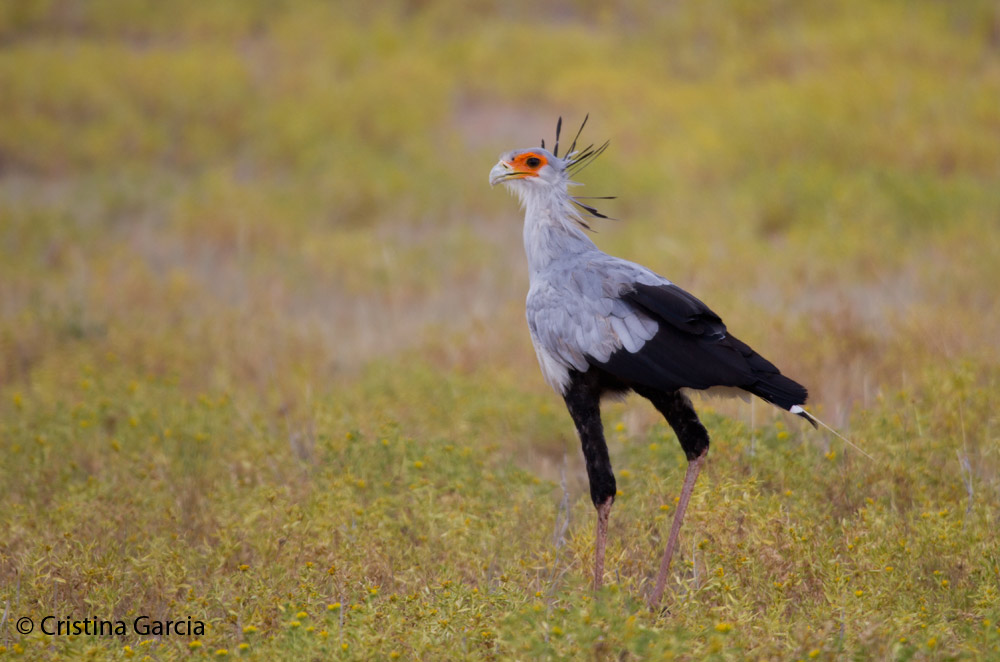
Found primarily in open grasslands and savanna in sub-Saharan Africa, from coastal regions to high altitudes, and tend to avoid wooded areas. It is a common sight in places like the Kalahari Desert (such as Etosha National Park in Namibia or in the Kgalagadi Transfrontier Park and the Karoo National Park in South Africa).
Here are some of the secretary bird facts that most fascinate us:
Fun Fact! The secretary bird is the bird featured in the coat of arms of South Africa and Sudan.
Is the Secretary Bird an Eagle?
The secretary bird is not an eagle, but if we look at the secretary bird’s lineage we see it is related to them. Both eagles and secretary birds belong to the same order, the Falconiformes.
The order Falconiformes contains five families:
- Falconidae (falcons and caracaras)
- Accipitridae (hawks, eagles, kites, harriers, and Old World vultures)
- Pandionidae (ospreys)
- Cathartidae (New World vultures)
- Sagittriidae (secretary birds)
How the Secretary Bird Got Its Name
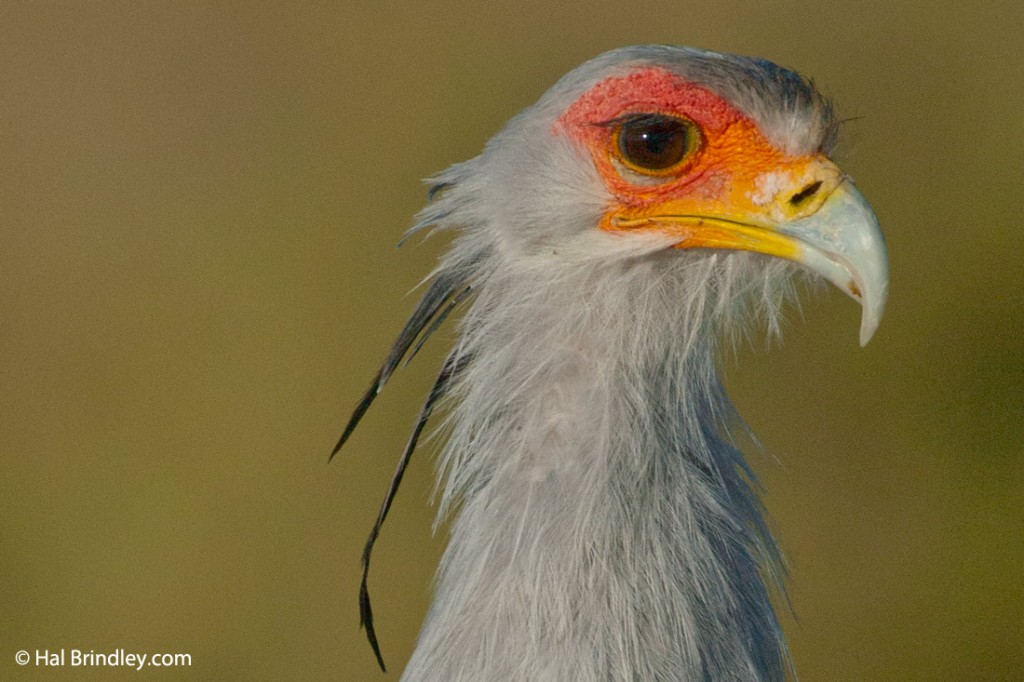
Why is it called a Secretary Bird? The bird’s long, black crest feathers (at the back of its head) resemble the quill pens that secretaries in the 19th century kept tucked into their hair and behind their ears.
These black crest feather and the long eyelashes are their distinctive feature.
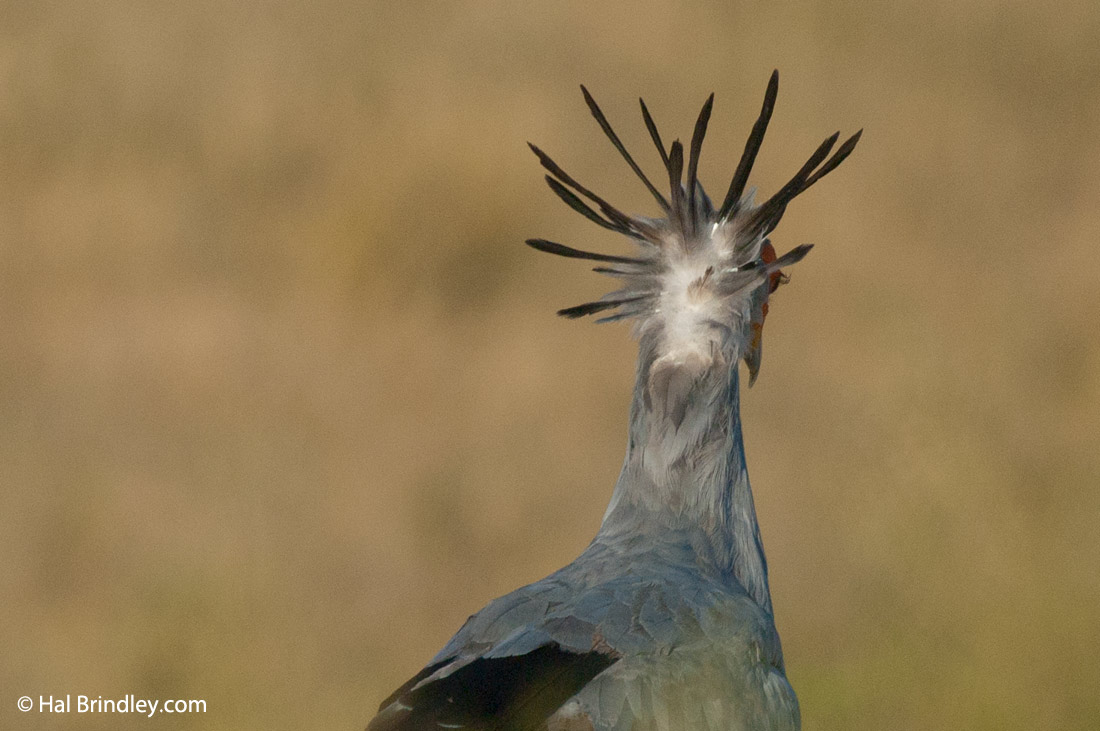
Another theory on why they are called Secretary Bird is that the name is a distortion of the French/Arabic “saqur et-air” meaning “hunting bird”.
Their scientific name has another origin. The Latin word sagittarius means “archer” and refers to its striding gait resembling a bow-hunter advancing to shoot. The species name serpentarius comes from the Latin serpentis referring to one of their favorite meals: snakes.
Secretary Birds are Terrestrial Birds of Prey
A terrestrial bird of prey hunts for its food on foot as opposed to other birds of prey who hunt during flight.
The Secretary Bird is one of the only two birds of prey in the world that hunts on foot. The other terrestrial bird of prey is the caracara, found in the Americas.
Secretary birds have the longest legs of any bird of prey
Their legs are the longest in any bird of prey, that’s why secretary birds are over 4ft tall!
Secretary bird diet, what do secretary birds eat?
Secretary birds can walk up to 20km per day while foraging. They prefer open areas. Their varied diet consists of small animals like snakes, spiders, small birds, small tortoises, small mammals, large insects, small rodents, and carrion.
Their hunting method is peculiar. When prey is located, the secretary bird stomps on it until it is subdued. If it is hunting one of the venomous snakes found in their territory, it leans back while punching the snake to avoid a possible strike. Small prey is swallowed whole while bigger prey is torn apart.
They are also opportunistic predators, always keeping an eye on anything that could be a meal.
We’ve seen pairs of secretary birds hunting together. The video below shows how a pair of Secretary Birds hunt and forage. We took this video of the terrestrial hunters in the Kgalagadi,
Raptors on Stilts
Secretary Birds have the longest legs in the raptor world. They are three times as long as the legs of any other raptor. Their lower legs are covered in scales, just like in the other serpent eagles, the Bateleur eagles. The scales on their legs protect them from snake bites.
If it Looks Like a Crane and Looks Like a Crane, it Could be a Secretary Bird
Secretary birds in flight can be mistaken for cranes as they have a very crane-like body. If you spot a barred tail, you are watching a secretary bird. Their crane-like legs are also unmistakable as their “black leggings” are conspicuous.
Ground Hunter At Day, Tree Rooster At Night
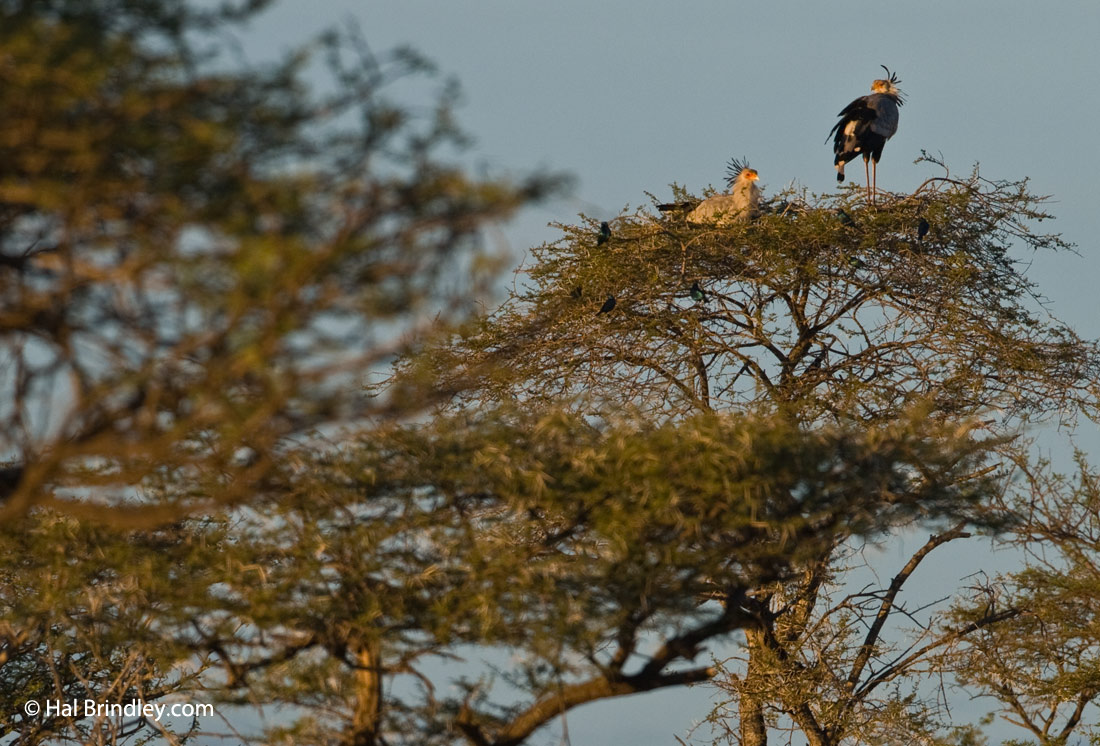
Even though Secretary Birds spend all day foraging on the ground, they spend their nights roosting on the tops of thorny acacia trees where they are safe from big predators like lions and leopards.
Breeding and Nesting Behavior of Secretary Birds
Secretary birds are monogamous, spending their lives with their partner.
These monogamous pairs build their large nests by making a platform out of sticks and lining it with grass found nearby. These nests are built on flat-topped trees, preferably thorn trees, such as those in the Acacia family. If there is no tree available, the pair will choose a high bush instead. The nests built by secretary birds are big, like the one in the photo below, taken in the Karoo National Park, South Africa.
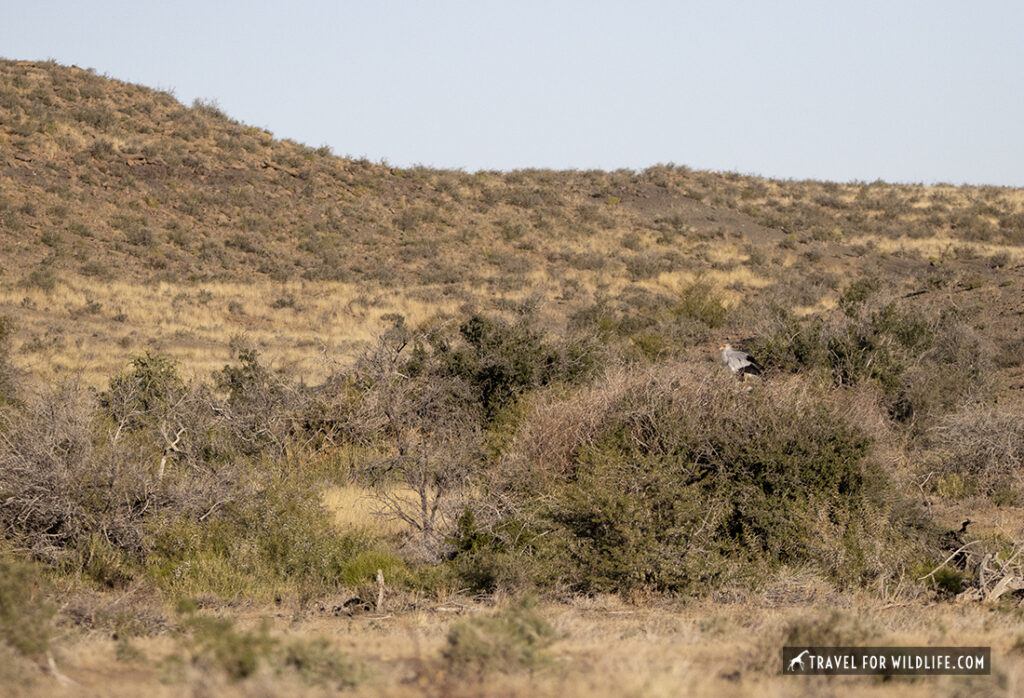
We actually saw this pair of secretary birds build their nest. One of them (we couldn’t tell if it was the male or the female) would fly down to the open grasslands in front of their nest to gather some nesting material. The mating pair build the nest together. Once back at the nest, and with the material in it, the other one would sit on it as if it was compressing it and making the whole nest cozy. We guess the one doing the gathering in the tall grass was the male, since that’s what we’ve seen in our yard with our wild birds.
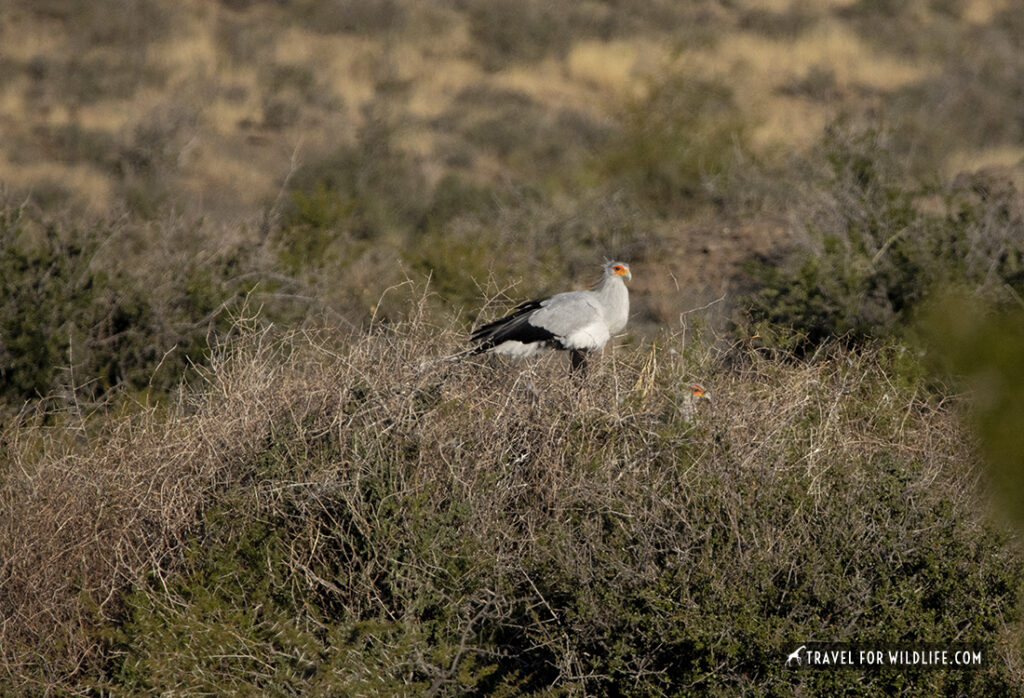
The female will normally lay 1-3 pale-green eggs or blue-green eggs during the late dry season or beginnings of the wet season. Both parents share the incubation duties and once the chicks are born, also share the feeding.
The young secretary bird chicks are born covered in light grey down, becoming darker after two weeks. Their legs are yellow and their crest of long feathers will appear at 3 weeks of age while the flight feather will appear after that, at 4 weeks. The young secretary birds fledge after 2-3 months.
Juvenile birds have a shorter tail and present a yellow face, not red like the adults do.
Threats to Secretary Birds
Secretary birds are endangered and recent surveys suggest that their numbers are declining. This is due primarily to habitat degradation (urbanization, agriculture), and habitat loss.
Climate change is also a threat to this species. As droughts become more severe their mortality will increase.

Cristina Garcia
Zoologist and wildlife photographer. She has worked in the field with jackals, wolves, cheetahs, & leopards. She serves on the Board of Directors of SEE Turtles, a non-profit sea turtle conservation organization.
Read her posts at Travel For Wildlife and see more of her work at Truly Wild, & Our Wild Yard.
Jordi C.
Monday 19th of November 2012
So cool! Vimos a una cazar en la concesión de Jock Safari Lodge en Kruger.